
Scale Your Reach with a Top Progressive Web App Development Company
The biggest hurdle in mobile growth isn't usually the quality of the product—it's the friction of the "install." Asking a user to leave their browser, open an app store, enter a password, and wait for a download is a lot to ask. By the time the app is installed, you've already lost a significant percentage of your potential users.
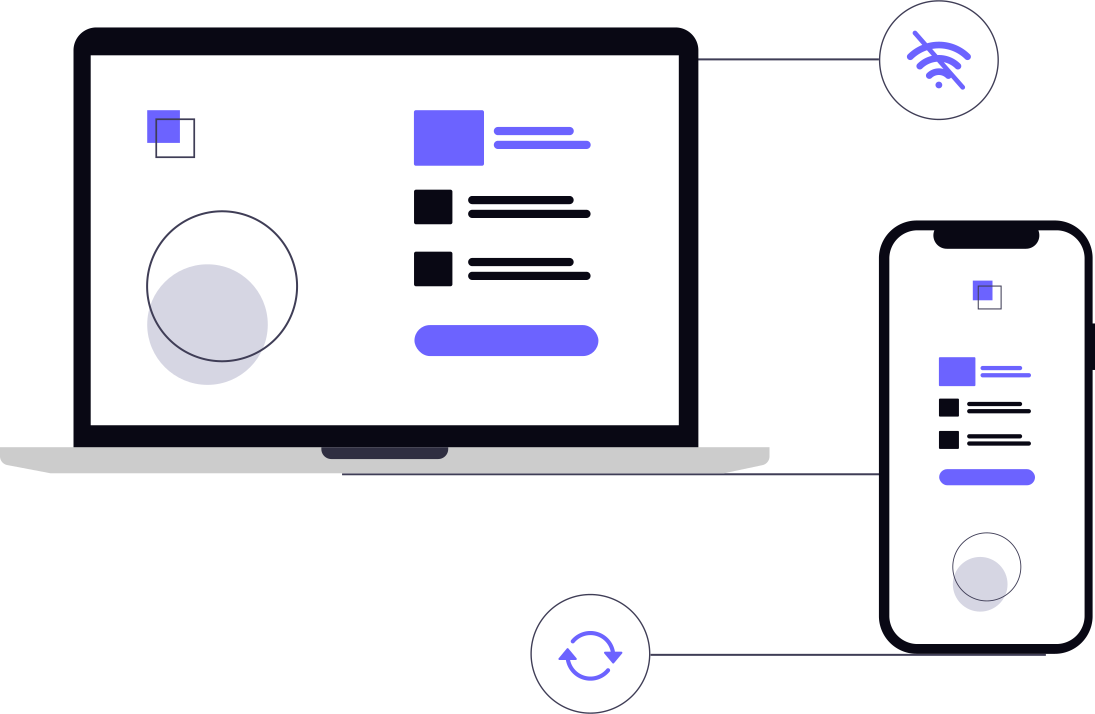
This is where Progressive Web Apps (PWAs) change the math. A PWA gives you the best of both worlds: the discoverability and instant access of a website, paired with the speed and feel of a native mobile app. When you work with an experienced progressive web app development company, you aren't just building a website; you're creating a lightweight, installable experience that lives on the user's home screen without the app store baggage.
The Practical Reality: Why PWAs Make Business Sense
Many companies feel they have to choose between a mobile-responsive website and a native iOS/Android app. In reality, that choice is often a false dichotomy. Native apps are powerful, but they are expensive to build and maintain across different operating systems. Websites are easy to reach, but they often feel clunky and fail the moment the internet connection drops.
PWAs solve this by using a combination of service workers and web app manifests. For a business owner, this translates to several tangible advantages:
- Lower Acquisition Cost: Since PWAs are indexed by search engines, your "app" is discoverable via Google. You don't have to spend your entire marketing budget just to get people to the App Store.
- Reduced Development Overhead: Instead of managing three separate codebases (Web, iOS, Android), you maintain one. This significantly lowers the long-term maintenance cost.
- Instant Updates: There is no "waiting for approval" from Apple or Google. When you push an update to your server, every user sees it the next time they load the app.
- Offline Resilience: Through intelligent caching, PWAs can allow users to browse previously viewed pages or complete certain tasks even when they are in a dead zone.
Common Pitfalls When Building a PWA
While the tech is powerful, it's easy to get it wrong. We often see businesses treat a PWA as just "a website that works offline." That approach usually leads to a poor user experience. To actually scale your reach, you need to focus on the "app" part of the Progressive Web App.
One common mistake is neglecting the App Shell architecture. Without a proper shell—the minimal HTML, CSS, and JS required to power the UI—the app will still feel like a webpage that's loading. A professional development team ensures the shell loads instantly, while the dynamic content fills in as it becomes available. This creates that "snappy" feeling users expect from native apps.
Another operational bottleneck is over-engineering the offline mode. Not every part of your business needs to work offline. Trying to make a complex, data-heavy dashboard fully functional without a connection often leads to sync conflicts and data corruption. The key is identifying the "critical path"—the 20% of features that provide 80% of the value offline—and perfecting those.
Choosing the Right Progressive Web App Development Company
Not every web agency is equipped to build a high-performance PWA. Many can make a site "responsive," but building a true PWA requires a deeper understanding of browser APIs and caching strategies. When evaluating a partner, look for these specific capabilities:
Performance Optimization and Core Web Vitals
A PWA that loads slowly is just a slow website. Your partner should be obsessed with LCP (Largest Contentful Paint) and CLS (Cumulative Layout Shift). If they can't explain how they plan to optimize your asset delivery, they aren't the right fit.
Strategic Tech Stack Selection
Depending on your goals, the framework matters. Whether it's React, Vue, or Angular, the choice should be based on your existing ecosystem and scaling needs. If you are planning for massive growth, you should look into building scalable web applications for high user traffic to ensure your PWA doesn't crash during a peak marketing surge.
UX/UI for "App-Like" Interaction
A PWA shouldn't just look like an app; it should behave like one. This means implementing smooth transitions, gesture-based navigation (like swiping to go back), and a bottom-navigation bar that feels natural on a thumb-driven screen. If the design feels like a shrunk-down desktop site, your users won't bother adding it to their home screen.
PWA vs. Native: When to Use Which?
We aren't suggesting that native apps are obsolete. They still have a place, especially for high-performance gaming, heavy video editing, or apps that require deep integration with hardware (like advanced Bluetooth sensors or complex background processing).
However, for the vast majority of e-commerce, content platforms, and internal business tools, a PWA is the more logical choice. If your primary goal is to scale your online presence quickly and cost-effectively, the PWA route removes the friction that kills conversion rates.
The decision usually comes down to this: Do you need the absolute maximum power of the device's hardware, or do you need the maximum number of people to actually use your software? If it's the latter, PWA is the winner.
The Implementation Roadmap
Scaling your reach isn't an overnight event. It happens in stages. A seasoned progressive web app development company will usually guide you through a phased rollout:
- Audit and Strategy: Analyzing current user behavior to see which features are most critical for a mobile-first experience.
- The MVP Phase: Building the core functionality and the App Shell to test the "install" rate and user engagement.
- Service Worker Integration: Implementing the caching logic that allows for offline access and push notifications.
- Optimization Loop: Using tools like Lighthouse to find performance bottlenecks and refining the load times.
- Growth and Scaling: Expanding the feature set based on real-world usage data.
Final Thoughts on Scaling Your Reach
The goal of any digital product is to be where the user is, with as little effort on their part as possible. The "App Store wall" is a real barrier that many businesses ignore until they see their acquisition costs skyrocketing. By adopting a PWA strategy, you effectively tear down that wall.
Whether you are migrating an existing site or starting from scratch, the focus should always be on removing friction. When the experience is seamless, fast, and accessible, your users will naturally engage more deeply with your brand.
Frequently Asked Questions
Do PWAs work on iPhones (iOS)?
Can I send push notifications through a PWA?
Will a PWA help my SEO rankings?
Is it expensive to convert a website into a PWA?
Book a strategy call
From zero-to-one product development to scaling infrastructure. Pinakinvox partners with high-growth teams to solve complex technical challenges.
Recommended by professionals.
Everything published here is tested and deployed in live production systems. No theories.