
The Future of Shopping: How Augmented Reality in Ecommerce is Changing Consumer Behavior
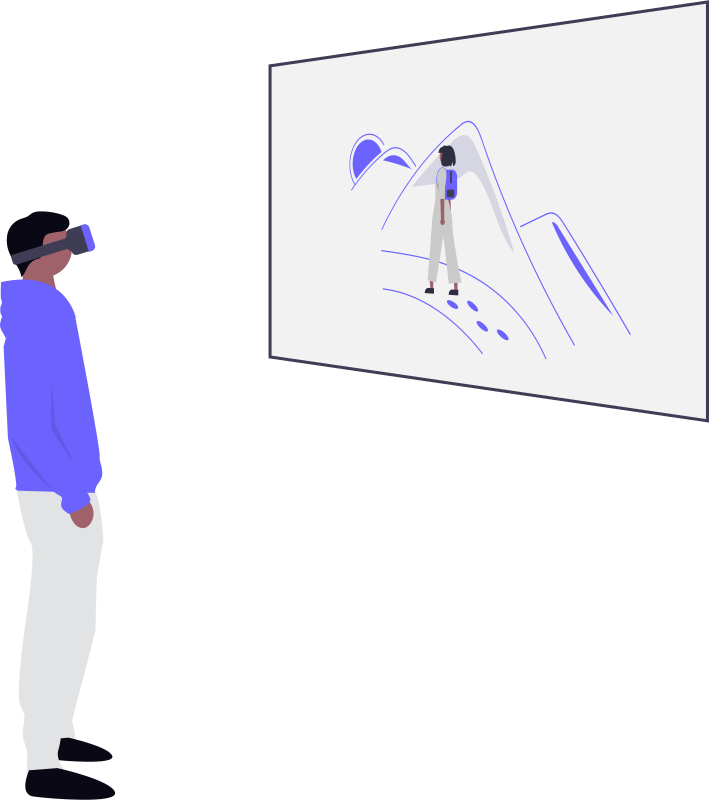
Online shopping solved convenience. It never fully solved confidence.
That gap shows up in the data every quarter: high browse rates, abandoned carts, and return piles that eat into margins. Shoppers want the ease of buying from home without the nagging question of whether the product will actually work in their space, on their face, or on their body.
Augmented reality in ecommerce is one of the few tools that addresses that question directly. Not by adding more product photos, but by letting people see items in context before they pay. And that shift is changing how consumers research, compare, hesitate, and finally commit.
The Confidence Problem AR Actually Solves
Most ecommerce friction is not about price. It is about uncertainty.
Will this sofa fit through the door? Does this lipstick shade suit my skin tone? Will these trainers look right with what I already own? Traditional product pages answer these questions with static images, size charts, and reviews from strangers whose homes look nothing like yours.
AR closes part of that gap by overlaying digital product models onto the real world through a phone camera. A customer can place a lamp on their bedside table, preview a shade of foundation on their face, or spin a handbag around in 3D. The experience is not perfect. Lighting varies. Tracking can glitch. But for many categories, it is meaningfully better than guessing.
What changes is not just the interface. It is the mental model. Shoppers stop treating the product page as a brochure and start treating it as a trial. That is a subtle but important behavioural shift.
How Shopping Behaviour Is Actually Changing
When AR works well, it tends to affect behaviour in a few predictable ways.
People spend longer on high-intent products
AR sessions are rarely casual scrolling. A user who opens a "view in your room" tool is usually close to a decision. They are measuring, comparing, maybe showing a partner. Session depth goes up. So does time on product pages—but often in a focused way rather than aimless browsing.
Returns drop in visual categories
Furniture, eyewear, cosmetics, and home décor see the clearest return-rate improvements when AR is done properly. A customer who has virtually placed a bookshelf against their wall is less likely to return it because "it looked different in the photos." The expectation is already calibrated to their space.
The effect is weaker for commodities where fit and context matter less. Nobody needs AR to preview a phone charger.
Mobile becomes the default research channel
AR lives on phones. That pushes more of the consideration phase into mobile apps and mobile web, even when the final purchase happens on desktop. Retailers who treat mobile as a checkout shortcut miss this. The phone is increasingly where doubt gets resolved.
Social sharing enters the purchase loop
People screenshot AR previews. They send them to flatmates, spouses, parents. "Does this work in our living room?" becomes a message thread, not a weekend store visit. Shopping gets more collaborative, which can speed up decisions—or surface new objections you did not anticipate.
Where AR Works—and Where It Does Not
Not every category benefits equally, and pretending otherwise is one of the more common mistakes retailers make.
Strong fits:
- Home and furniture: Scale and spatial fit are hard to judge from photos. IKEA Place set expectations here years ago, and the category still leads AR adoption.
- Beauty and cosmetics: Virtual try-on for lipstick, eyeshadow, and hair colour reduces shade-mismatch returns.
- Eyewear: Frame sizing and face shape matter enormously. AR try-on is now close to standard for online optical retailers.
- Fashion accessories: Bags, watches, and jewellery preview well. Full clothing try-on is improving but still uneven.
Weaker fits:
- Low-margin, high-SKU commodity goods
- Products where tactile feel matters more than appearance—fabrics, mattresses, certain foods
- Categories with inconsistent 3D asset quality across suppliers
The honest rule: if the main purchase anxiety is visual or spatial, AR probably helps. If it is tactile, AR is a sideshow.
From Novelty to Normal: The Adoption Curve
Early AR in ecommerce felt like a marketing stunt. Brands launched AR filters, got press coverage, and moved on. That phase is largely over.
What we are seeing now is quieter integration. AR buttons sit next to "Add to Cart" on product pages. WebAR—browser-based experiences that do not require a separate app download—has lowered the friction significantly. A customer on a product listing can tap "View in AR" and use their camera without installing anything. That matters in markets like India, where storage space and data costs still influence app adoption.
Consumer expectations are shifting accordingly. Shoppers in furniture and beauty increasingly expect try-before-you-buy tools. When a competitor offers AR and you do not, the absence is noticeable—not because AR is flashy, but because the alternative feels dated.
For teams building or upgrading their store, this sits alongside other mobile priorities covered in guides like what makes a successful ecommerce mobile app in 2026. AR is not a standalone feature. It needs to load fast, work on mid-range Android devices, and sit naturally inside the purchase flow.
What Retailers Underestimate About Implementation
The technology is more accessible than it was five years ago. The operational work is still substantial.
3D asset creation and maintenance
Every SKU you want in AR needs a usable 3D model. That means photography or scanning workflows, file optimisation for mobile, and updates whenever packaging or design changes. For a catalogue of 50 hero products, this is manageable. For 10,000 SKUs, it is a content operation—not a one-time dev project.
Device and lighting variability
AR that looks brilliant on an iPhone 15 in a well-lit showroom can struggle on an older Android in a dim bedroom. Testing across devices is not optional. Neither is graceful degradation when AR is unavailable.
Integration with existing stacks
AR modules need to pull live pricing, stock status, and variant data from your PIM or ecommerce platform. A beautiful 3D sofa that shows the wrong colour variant is worse than no AR at all. Platform choice matters here—whether you are on Shopify, Magento, a custom build, or a dedicated ecommerce app development roadmap from concept to launch.
Measuring what matters
AR engagement rate is a vanity metric on its own. What you want to track:
- Conversion rate for AR users vs non-AR users on the same SKU
- Return rate differential
- Average order value when AR is used for cross-sell (e.g., placing multiple items in a room)
- Drop-off points inside the AR experience itself
Without this data, you cannot justify the ongoing asset costs.
The Business Case, Without the Hype
AR is not cheap to do well, but it does not need a blockbuster budget either. A focused pilot on 20–30 high-return SKUs in one category often tells you more than a platform-wide rollout.
Typical investment areas:
- 3D modelling or photogrammetry per product
- SDK licensing (ARKit, ARCore, or third-party platforms like Shopify AR, Snap, or dedicated providers)
- Frontend integration and QA
- Ongoing content updates
ROI shows up through reduced returns, higher conversion on expensive items, and lower customer support queries about sizing and fit. It rarely shows up overnight. Most teams need a full quarter of data before patterns become clear.
Smaller D2C brands should ask a direct question: does return rate on our top five products justify the modelling cost? If those five products account for 40% of revenue and 60% of returns, the maths often works. If AR is spread thin across the entire catalogue with no prioritisation, it usually does not.
Privacy, Trust, and the Camera Question
AR requires camera access. That raises legitimate concerns, especially in markets with growing data privacy awareness.
Best practice is straightforward: request camera permission only when the user initiates AR, explain why, and avoid storing raw camera footage unless there is a clear user benefit and consent. For virtual try-on in beauty, some platforms process frames on-device rather than uploading to servers—a detail worth confirming with your vendor.
Trust also extends to accuracy. If a virtual lipstick colour looks nothing like the delivered product, you have traded one disappointment for another. Colour calibration and realistic rendering are not cosmetic details. They are retention issues.
What Comes Next
A few directions are worth watching, without treating any of them as imminent revolutions.
AI-assisted room scanning is improving how furniture AR handles occlusion—digital objects appearing behind real ones rather than floating on top. That makes previews more believable.
Shared AR sessions could let two people in different cities view the same product placement simultaneously. Useful for joint purchasing decisions, though adoption is still early.
AR in physical retail is merging with ecommerce data. Scan a product in-store, see your purchase history, check if it matches what you previewed online. The online-offline boundary keeps blurring.
Generative customisation may eventually let shoppers modify product attributes in AR in real time—change fabric, leg style, finish—without pre-rendering every variant. That would reduce the 3D asset bottleneck significantly, but production-ready tools are not mainstream yet.
For most retailers in 2026, the practical move is not chasing every trend. It is picking one category where visual uncertainty costs you money, building AR properly for that category, measuring results, and expanding only when the numbers support it.
Frequently Asked Questions
Does augmented reality in ecommerce actually increase sales?
Do customers need a special app to use AR shopping features?
How much does it cost to add AR to an ecommerce store?
Which product categories benefit most from AR?
Is AR worth it for small ecommerce businesses?
Closing Thought
Augmented reality in ecommerce is not replacing physical stores or static product photography. It is filling a specific gap—the moment between interest and purchase when a customer needs to believe the product will work in their life.
Consumer behaviour is shifting toward that expectation quietly. Shoppers who experience good AR once start looking for it elsewhere. Retailers who treat it as a permanent part of product content—not a one-off campaign—are the ones seeing sustained impact on returns, conversion, and trust.
The future of shopping was never going to be fully virtual or fully physical. It is going to be contextual. AR is one of the more practical tools we have for making online shopping feel a little less like a gamble.
Book a strategy call
From zero-to-one product development to scaling infrastructure. Pinakinvox partners with high-growth teams to solve complex technical challenges.
Recommended by professionals.
Everything published here is tested and deployed in live production systems. No theories.