
Revolutionizing Patient Care: The Power of Analytics and Healthcare Integration
For a long time, the "data" in healthcare was essentially a digital filing cabinet. We moved from paper charts to Electronic Health Records (EHRs), but for many providers, that was where the journey ended. The data was there, but it was static. You had to go looking for it, and by the time you found a pattern, the patient had often already been discharged.
The real shift happens when we stop treating data as a record of the past and start using it as a tool for the present. When we talk about analytics and healthcare today, we aren't just talking about fancy dashboards or annual reports. We are talking about integration—the ability to pull data from wearables, lab results, and administrative logs into a single stream that tells a doctor exactly who is at risk before the crisis hits.
Moving Beyond the "Digital Filing Cabinet"
Many hospitals make the mistake of thinking that buying an expensive analytics platform is the same as having a data-driven strategy. It isn't. The biggest bottleneck isn't the software; it's the silos. You have clinical data in one system, billing in another, and patient-reported outcomes in a third. If these don't talk to each other, your analytics are only giving you a fragmented view of the patient.
True integration means creating a unified data layer. When a patient’s heart rate spikes on a wearable device and that data triggers an alert in the EHR, which then prompts a pharmacy check for medication adherence, that is where the value lies. This level of connectivity is what allows for "precision medicine"—treating the individual based on their specific data markers rather than a general protocol for their age group.
Practical Applications: Where Data Actually Saves Money and Lives
It is easy to get caught up in the hype of AI, but the most immediate wins in healthcare analytics are often the most practical ones.
Reducing the 30-Day Readmission Cycle
Readmissions are a massive drain on resources and a sign of fragmented care. By applying predictive analytics, hospitals can now assign "risk scores" to patients before they leave. If the data shows a patient lives alone, has a history of non-compliance with meds, and has a specific comorbidity, the system flags them for a more intensive follow-up plan. It’s not about magic; it’s about using historical patterns to predict future failures.
Operational Efficiency and Staffing
One of the most overlooked areas of analytics and healthcare is the "back office." Staffing shortages are a global crisis, but often the problem is a mismatch of supply and demand. Analytics can predict peak ER hours based on seasonal trends, local events, or even weather patterns. Instead of guessing how many nurses are needed on a Tuesday night, administrators can use data to optimize shifts, reducing burnout and cutting unnecessary overtime costs.
Preventative Population Health
Instead of waiting for patients to show up sick, integrated analytics allow providers to manage "populations." For example, a clinic can run a query to find every diabetic patient who hasn't had an A1C test in six months. By proactively reaching out to this specific group, they prevent emergency room visits and improve long-term health outcomes across the entire community.
The Reality of Implementation: It’s Not Always Smooth
If you've ever tried to implement a new software system in a clinical setting, you know that "resistance to change" is an understatement. Doctors are overworked and often view new data tools as "just another screen to click through."
The most common mistakes we see include:
- Over-alerting: Creating too many notifications, leading to "alarm fatigue" where clinicians simply ignore the warnings.
- Poor Data Hygiene: Trying to run advanced analytics on "dirty" data (duplicate records, missing fields, or inconsistent formatting).
- Ignoring the Workflow: Building a tool that is technically brilliant but adds three minutes to a doctor's consultation.
To avoid these pitfalls, the focus must be on optimizing clinical workflows. The analytics should be invisible—embedded directly into the tools the staff already use, providing a "nudge" rather than a new task.
The Integration Stack: How it Actually Fits Together
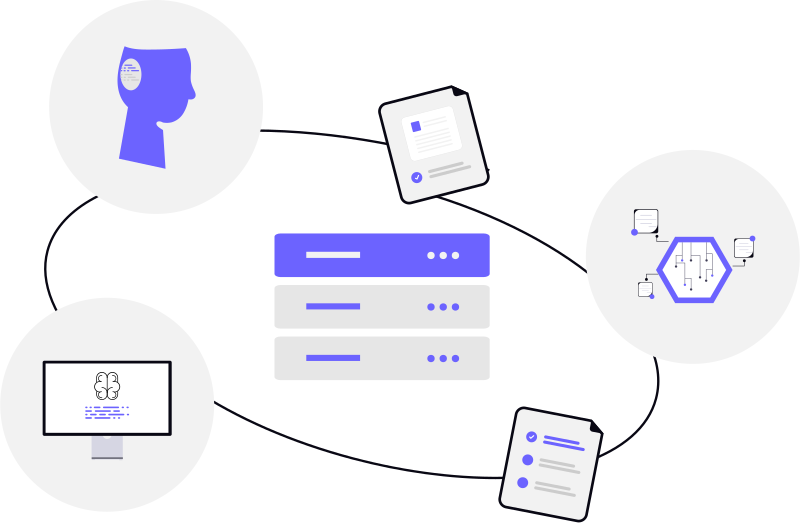
For those looking at the technical side, the architecture usually follows a specific flow. You start with Data Ingestion (pulling from EHRs, IoT devices, and insurance claims). Then comes Data Normalization, where different formats are converted into a standard language (like FHIR). Finally, the Analytics Layer applies the logic—whether it's a simple descriptive report or a complex machine learning model.
Many organizations are now moving toward cloud-based infrastructures to handle this load. The sheer volume of genomic data and high-resolution imaging makes on-premise servers impractical. This is why cloud computing in healthcare has become the backbone for modern analytics; it provides the elasticity needed to process massive datasets without crashing the hospital's local network.
The Human Element: Ethics and Privacy
We cannot talk about data without talking about trust. In healthcare, a data breach isn't just a financial loss; it's a violation of a patient's most private information. As we integrate more analytics, the "black box" problem becomes a concern. If an algorithm suggests a treatment plan, the doctor needs to know why. We cannot replace clinical judgment with a score; we must use the score to inform the judgment.
Moreover, there is the risk of algorithmic bias. If the data used to train a model doesn't represent a diverse population, the "insights" generated might be inaccurate for certain ethnic or socio-economic groups. Ethical analytics require constant auditing and a human-in-the-loop approach.
Looking Ahead: The Proactive Era
The goal of integrating analytics and healthcare is to move from reactive care (treating the sick) to proactive care (maintaining the healthy). We are moving toward a world where your health data is a living document, updated in real-time, and analyzed by systems that can spot a decline in health weeks before a patient feels a single symptom.
For healthcare providers, the competitive advantage will no longer be just about having the best surgeons or the newest machines—it will be about who has the best data integration. The winners will be those who can turn a mountain of raw data into a clear, actionable path for every single patient.
Frequently Asked Questions
What is the difference between healthcare data and healthcare analytics?
How does data integration improve patient safety?
Is it expensive to implement healthcare analytics?
How do you handle patient privacy with big data?
Conclusion
The intersection of analytics and healthcare is where the most significant gains in patient care are currently happening. By breaking down data silos and integrating real-time information, we can move away from a "one size fits all" approach to medicine. However, the technology is only as good as the workflow it supports. The real success lies not in the complexity of the algorithm, but in how naturally that insight fits into the hands of the clinician at the bedside.
Book a strategy call
From zero-to-one product development to scaling infrastructure. Pinakinvox partners with high-growth teams to solve complex technical challenges.
Recommended by professionals.
Everything published here is tested and deployed in live production systems. No theories.