
Inside Cash App by Square Inc: How It's Redefining Digital Payments and Investing
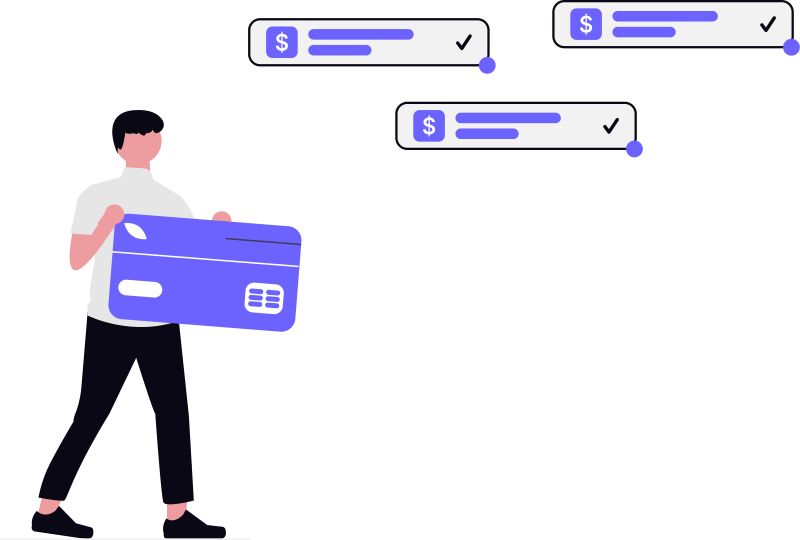
Most people start using Cash App for one simple reason: they need to split a dinner bill or send a quick payment to a friend without digging for bank details. But if you look closely at the trajectory of cash app by square inc, it is clear that P2P payments were just the hook. What they've actually built is a full-stack financial hub that challenges the very definition of a "bank."
For those of us who follow fintech, the brilliance of Cash App isn't just in the code, but in the psychological shift it created. It moved money from being a "chore" managed in a heavy banking app to a "social activity" managed in a lean, fast interface. By stripping away the intimidation of traditional finance, Square Inc has managed to capture a demographic that usually avoids brokerage accounts and savings bonds.
The Pivot from Wallet to Ecosystem
In the beginning, the value proposition was simple: speed. But Square Inc knew that being a "utility" is a dangerous place to be—utilities are easily replaced. To avoid this, they pivoted toward an ecosystem model. They didn't just add features; they added entire financial verticals.
First came the Cash Card. By introducing a physical debit card, they moved the app from the "occasional use" category to the "daily use" category. Suddenly, the app wasn't just for sending money; it was where your paycheck landed and where you bought your morning coffee. This created a closed loop where users keep their funds within the app, reducing the friction of moving money back and forth to traditional banks.
Then came the integration of Bitcoin and stocks. This was a strategic masterstroke. By allowing users to buy fractional shares or small amounts of BTC with as little as $1, they democratised investing. They realised that for a huge portion of the population, the barrier to investing isn't just money—it's the complexity of the onboarding process. By leveraging the existing KYC (Know Your Customer) data from the payment side, they made the jump to investing a one-tap experience.
The Architecture of Accessibility
From a product perspective, the success of cash app by square inc lies in its refusal to look like a financial tool. Traditional banking apps are cluttered with menus, statements, and corporate jargon. Cash App does the opposite. It uses a minimalist UI that feels more like a social media app than a ledger.
However, this simplicity hides a massive amount of operational complexity. Handling real-time payments, managing brokerage licenses, and securing cryptocurrency wallets requires a robust backend. For any business looking to build something similar, the challenge isn't the UI—it's the regulatory and security layer. This is why building secure mobile payment applications is such a high-stakes endeavour; one security lapse can destroy user trust instantly.
One observation from the industry is that Cash App excels at "feature layering." They don't launch a massive, complex update. Instead, they roll out small, high-impact tools—like "Boosts" (instant discounts at specific merchants)—that provide immediate, tangible value to the user. This keeps the app feeling fresh without overwhelming the user experience.
The Investing Angle: Fractionalisation and Psychology
The move into stock trading put Cash App in direct competition with platforms like Robinhood. But their approach is slightly different. While other apps focus on "trading" (the act of buying and selling for profit), Cash App focuses on "owning."
By pushing fractional shares, they've removed the "sticker shock" of expensive stocks. You don't need $3,000 to own a piece of a tech giant; you just need a few dollars. This shifts the user's mindset from "I can't afford to invest" to "I can start with what I have."
But this approach isn't without its risks. The "gamification" of investing is a recurring critique in fintech. When investing becomes as easy as sending a text, there is a risk that users may treat their portfolios like a game. Square Inc has attempted to mitigate this with simple guides, but the tension between "extreme ease of use" and "responsible investing" remains a core challenge for the platform.
Operational Realities and Business Trade-offs
Building a product like this involves significant trade-offs. To maintain that lightning-fast speed, you often have to sacrifice some of the granular control that power users want. You won't find complex technical analysis charts in Cash App because that would alienate the average user. They've chosen "broad appeal" over "expert depth."
Another reality is the cost of customer acquisition. By offering zero-fee trading and instant payment features, the company essentially subsidises the user experience to grow its market share. The goal isn't necessarily to make a profit on every single $1 stock trade, but to own the entire financial relationship of the user. Once a user has their salary, their savings, and their investments in one place, the "switching cost" becomes incredibly high.
For startups trying to replicate this, the biggest mistake is trying to build everything at once. Square Inc didn't launch a "Payment-Investing-Banking" app on day one. They started with a narrow, high-frequency use case (P2P payments) and expanded only after they had achieved a critical mass of users. This lean approach to MVP development is what allowed them to iterate based on actual user behaviour rather than assumptions.
What This Means for the Future of Finance
The trajectory of cash app by square inc suggests a future where "banking" is an invisible layer. We are moving toward a world where you don't "go to the bank" or even "open a banking app," but rather interact with a financial interface that fits into your social and commercial life.
We can expect to see further integration of AI to provide proactive financial advice—not just showing you a balance, but telling you when to move money into stocks based on your spending patterns. The goal is to move from a passive tool to an active financial assistant.
Frequently Asked Questions
Is Cash App a bank?
How does Cash App make money if trading is zero-fee?
Are the investments in Cash App safe?
Can I use Cash App for business purposes?
Final Thoughts
The success of cash app by square inc isn't just a win for Square; it's a blueprint for the next generation of digital services. They proved that if you remove the friction and the fear from a complex process—like investing or banking—you can unlock a massive, untapped market.
For the rest of us, the lesson is clear: the best products don't just add features; they remove barriers. By focusing on the user's emotional relationship with money, Cash App has transformed a boring utility into a daily habit.
Book a strategy call
From zero-to-one product development to scaling infrastructure. Pinakinvox partners with high-growth teams to solve complex technical challenges.
Recommended by professionals.
Everything published here is tested and deployed in live production systems. No theories.