
Cost of Developing a Mobile App: A Comprehensive Pricing Guide for Startups and Enterprises
If you've spent any time talking to development agencies, you know the most frustrating part of the process is the "it depends" answer. You ask for a price, and they ask for a 20-page requirements document. While it's true that every project is unique, the lack of transparency around the cost of developing mobile app projects often leaves founders and product managers guessing.
The reality is that app pricing isn't just about the number of screens or buttons. It's about the complexity of the logic, the quality of the infrastructure, and the long-term viability of the code. Whether you are a startup trying to validate an idea or an enterprise digitising a legacy process, understanding where the money actually goes is the only way to avoid budget overruns.
The Realistic Price Brackets for 2025-26
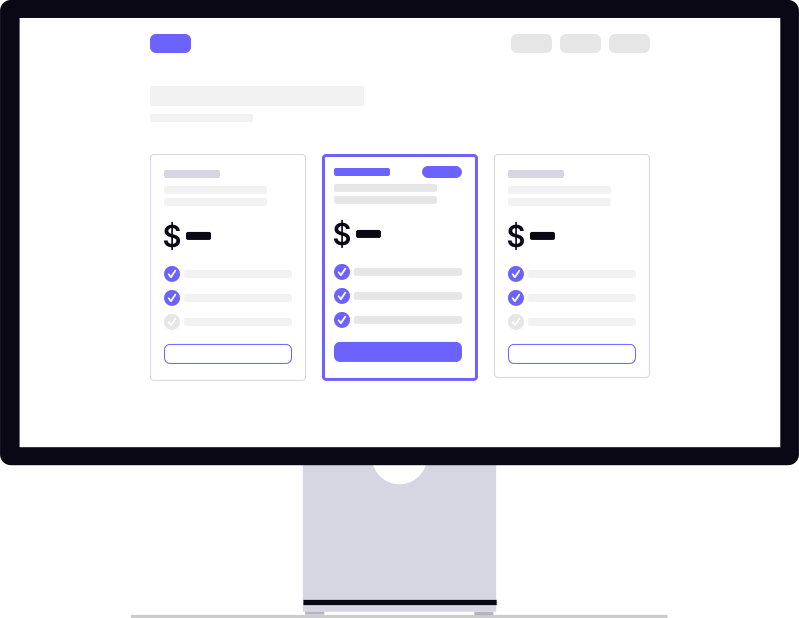
Instead of a single number, it's more helpful to look at apps in tiers of complexity. These aren't hard rules, but they serve as a baseline for what you should expect to pay for quality work.
- The MVP/Basic App ($30,000 – $70,000): This is for apps that do one or two things very well. Think of a simple directory, a basic tracking tool, or a content-delivery app. It has a clean UI, basic user authentication, and a simple backend.
- The Mid-Market App ($70,000 – $150,000): This is where most business apps sit. These include API integrations (like payment gateways), custom user roles, more sophisticated UI/UX, and a robust admin panel to manage data.
- The Enterprise/Complex App ($150,000 – $400,000+): These are heavy-duty platforms. We're talking about real-time synchronization, high-level security compliance (like HIPAA or GDPR), AI-driven personalization, and the ability to handle thousands of concurrent users without crashing.
A common mistake startups make is trying to build an "Enterprise" app on an "MVP" budget. This usually leads to "feature creep," where the project drags on for months, the budget vanishes, and you end up with a half-finished product that doesn't actually solve the user's problem.
What Actually Drives the Cost?
When a developer gives you a quote, they aren't just charging for the time it takes to write code. They are charging for the architecture that ensures the app doesn't break when you hit 10,000 users.
1. The Tech Stack Choice
Choosing between Native (Swift/Kotlin) and Cross-Platform (Flutter/React Native) is one of the biggest financial decisions you'll make. Native development offers the best performance but requires two separate codebases—effectively doubling the cost if you want both iOS and Android. Cross-platform allows you to write once and deploy to both, which significantly reduces the initial cost of developing mobile app projects without sacrificing much quality for most business use cases.
2. Backend and Infrastructure
The "app" is just the skin. The real work happens on the server. If your app requires real-time data, complex databases, or third-party integrations (like Salesforce or SAP), the backend cost will spike. You also have to account for cloud-based application development costs, as hosting and server management are recurring monthly expenses that scale with your user base.
3. UI/UX Design Depth
There is a massive price difference between using a standard template and hiring a UX designer to map out user journeys, conduct wireframing, and create high-fidelity prototypes. For a B2B tool, a clean, functional design is enough. For a consumer-facing app, a clunky interface is a death sentence, meaning you'll need to invest more in the design phase to ensure high retention.
4. Security and Compliance
If you are handling medical data, financial transactions, or sensitive personal info, you can't just "build it and see." Encryption, multi-factor authentication, and regulatory audits add significant hours to the development cycle. This is why a FinTech app costs triple what a lifestyle app costs, even if they have the same number of screens.
The "Hidden" Costs Most People Forget
The initial build is just the entry fee. Many businesses fail because they budget for the launch but forget the "Day 2" expenses. If you only budget for the build, you're setting yourself up for a crisis six months after launch.
Maintenance and Updates: OS updates (iOS 18, Android 15, etc.) can break features in your app. You'll typically need to spend 15-20% of the original development cost annually just to keep the app running smoothly.
Third-Party API Fees: Many "free" APIs are only free for the first 1,000 calls. Once you scale, services like Google Maps, Twilio (for SMS), or SendGrid (for email) start charging. These costs are operational, not development-based, but they eat into your margins.
Quality Assurance (QA): Testing isn't just clicking buttons. It's testing the app on ten different screen sizes, five different OS versions, and varying internet speeds. Skipping a professional QA phase usually results in a flood of 1-star reviews on the App Store upon launch.
Strategic Budgeting: How to Get the Most Value
If your budget is tighter than you'd like, the answer isn't to find the cheapest developer—that's a recipe for technical debt that will cost you double to fix later. Instead, change your approach to the build.
Start with a lean MVP. Focus on the one "killer feature" that solves the primary pain point for your user. By investing in professional MVP development, you can get to market faster, gather real user data, and use that data to justify the budget for the "Advanced" features in version 2.0.
Operational Trade-off: It is better to have an app with three perfect features than an app with ten buggy ones. Users will forgive a missing feature, but they won't forgive an app that crashes during a payment process.
Comparing Startup vs. Enterprise Budgeting
The way a startup and a corporation look at the cost of developing mobile app projects is fundamentally different.
For Startups: The goal is Validation. Every dollar spent should be aimed at proving the business model. Budgeting is often agile, with funds released in milestones. The risk is under-investing in the foundation, which makes scaling a nightmare later.
For Enterprises: The goal is Efficiency and Integration. The budget is usually larger, but the "red tape" is higher. Costs increase due to the need for extensive documentation, integration with legacy internal systems, and strict corporate security protocols. The risk here is "over-engineering"—building a massive, complex system that takes two years to launch, by which time the market has changed.
Frequently Asked Questions
How long does it actually take to build a professional app?
Can I reduce the cost by using a no-code platform?
Why is there such a big price difference between different agencies?
What is the most expensive part of app development?
Final Thoughts
The cost of developing mobile app projects is rarely a fixed number because software is a living product, not a static asset. The most successful companies don't look at the build as a one-time expense, but as a continuous investment in their customer experience.
If you're staring at a quote and wondering if it's fair, look beyond the hourly rate. Look at the proposed architecture, the QA process, and the post-launch support. A "cheap" app that no one uses or that crashes constantly is the most expensive mistake a business can make.
Book a strategy call
From zero-to-one product development to scaling infrastructure. Pinakinvox partners with high-growth teams to solve complex technical challenges.
Recommended by professionals.
Everything published here is tested and deployed in live production systems. No theories.